Insider Brief:
- Space-based QKD is gaining momentum as nations seek global quantum-secure communications beyond the distance limits of terrestrial networks, driven by rising cyber risk and geopolitical pressure.
- The space-based QKD market is projected to grow from roughly $500 million in 2025 to $1.1 billion by 2030, but high costs, atmospheric sensitivity, and low technology readiness levels delay large-scale commercial adoption until after 2035.
- China leads with operational satellite QKD systems, Europe is advancing sovereign capability through EuroQCI and EAGLE-1, and North America is accelerating demonstrator missions led by Honeywell, Boeing, and emerging commercial players.
Space-based Quantum Key Distribution (QKD) is rapidly emerging as a cornerstone of next-generation secure communications. While terrestrial QKD is expanding with national networks now operating in China, South Korea, Switzerland, and parts of Europe, its inherent distance limitations are pushing nations and companies toward satellite-based architectures capable of delivering quantum-resilient encryption on a global scale.
Driven by mounting cyber risks, intensifying geopolitical competition, and national security priorities, the space-based QKD Infrastructure & development market is projected to expand from approximately $500 million in 2025 to $1.1 billion by 2030, while cumulative end-user commercial opportunities from QKD more broadly could reach over $9 billion over the same period. However, despite rapid technical progress, large-scale commercial adoption is expected only after 2035, as satellite QKD systems remain costly to deploy, require globally distributed optical ground-station networks, and must still advance through multiple mission demonstrations and higher technology readiness levels. A major technical challenge also persists: space-to-ground QKD relies on single-photon laser links, which are highly susceptible to atmospheric conditions — cloud cover, turbulence, and weather can severely attenuate the signal, limiting availability and adding significant complexity to operational planning.
How Space Insider Identified the Top Companies
Space Insider’s Top 10 list is based on each company’s space-flight readiness, maturity of quantum payload technology, involvement in national programs, and demonstrated progress in commercialization and integration of satellite–ground QKD systems. Companies without demonstrated QKD capability or credible near-term missions were excluded.
Global Momentum: Key Developments Shaping the Market
China Continues to Lead
China remains the undisputed leader in space-based QKD. Its satellites—Micius and Jinan-1—have demonstrated multi-thousand-kilometer QKD links, intercontinental entanglement distribution, and the world’s most advanced satellite-based quantum communication tests. China’s roadmap points toward a multi-satellite quantum internet by 2030.
Europe Invests in Sovereignty
Europe’s flagship quantum initiative, EAGLE-1, led by SES, will conduct Europe’s first end-to-end QKD trials in 2026. The mission is a core component of EuroQCI, Europe’s sovereign quantum-secure communications network spanning ground and space segments.
North America Intensifies Efforts
Honeywell is building QEYSSat, Canada’s first space-based QKD demonstrator, targeting launch in 2026. In the United States, Boeing’s Q4S satellite and IonQ’s post-Capella acquisition plans indicate growing interest in quantum-secure space networks, backed by increasing federal investment.
Growing Caution from the U.S. and UK
Despite rising global momentum, both the U.S. and UK continue to express caution around QKD. In 2025, the U.S. National Security Agency (NSA), through updated CNSS Policy 15–related materials and dedicated post-quantum guidance, reiterated that QKD should not be used for securing National Security Systems, citing practical limitations including range, integration complexity, hardware vulnerabilities, and cost. Similarly, the UK’s National Cyber Security Centre (part of GCHQ) has advised that QKD does not address fundamental encryption needs and should not be prioritised over post-quantum cryptography. These cautionary stances do not halt research, but they signal that the U.S. and UK currently view QKD as complementary rather than core to their near-term quantum-safe strategies.
Early Commercial Constellations Are Taking Shape
SealSQ launched the first satellite in its six-satellite QKD/PQC constellation in January 2025, with the remaining spacecraft scheduled for deployment through late 2025 and 2026—positioning it as one of the earliest commercial quantum-security offerings in low-Earth orbit.
Japan’s NICT–NEC–Toshiba 2025 multi-vendor quantum backbone demonstration proved that high-rate quantum and classical signals can co-exist on the same carrier-grade fiber—an essential prerequisite for satellite downlinks into national networks.
Top 5 Companies Enabling QKD with Spacecraft & payload Technology
1. Chinese Academy of Sciences (CAS) / USTC (China)
With multiple QKD satellites launched, CAS/USTC leads the global race with pioneering experiments in entanglement distribution, satellite-ground QKD, and intercontinental quantum communication. Their scale, scientific depth, and flight heritage remain unmatched.
2. SES (Luxembourg)
As lead integrator and operator of EAGLE-1, SES heads a 20-partner European consortium that brings together satellite bus, quantum payload, and ground-station expertise. The spacecraft platform will be supplied by Italian company SITAEL; the quantum optical payload by Germany’s Tesat-Spacecom; and ground-station terminals (telescope + adaptive optics + fiber coupling) by a joint team led by TNO and Airbus Netherlands. Additional partners, including ID Quantique, will provide quantum-secure electronics and QRNG systems — together enabling Europe’s first sovereign, end-to-end satellite QKD service under the EuroQCI framework.
3. Honeywell (USA)
Honeywell is one of the few companies with direct contracts to build a space-flight-qualified QKD payload. As mission prime for Canada’s QEYSSat demonstrator, Honeywell is responsible for the microsatellite bus and the integrated QKD optical terminal (including the spaceborne receiver payload and associated laser-communication hardware), as well as the primary quantum ground station, leveraging its long-standing space-optics heritage and positioning it as a long-term North American leader in space-based QKD.
4. SpeQtral (Singapore/UK)
SpeQtral’s SpeQtre CubeSat (launched in November 2025) carries a space-qualified entangled-photon source developed with RAL Space and is now undergoing commissioning for its first space-to-ground quantum-link tests. Its upcoming SpeQtral-1 mission—built on a NanoAvionics 16U bus with an Mbryonics quantum-optical terminal—will serve as a commercial pathfinder for global QKD key-delivery services, reinforcing SpeQtral’s role at the intersection of government partnerships, optical-comms R&D, and hybrid satellite–fiber quantum-network deployment.
5. SealSQ (Switzerland)
SealSQ is breaking ground with the first commercial quantum-secure satellite constellation, integrating QKD and PQC hardware in orbit. Their WISeSaT platforms are among the earliest commercial implementations of quantum-resistant space communication.
Top 5 Companies Enabling QKD with Ground Station Technology
1. ID Quantique (Switzerland)
Part of IONQ since May 2025, ID Quantique provides space-qualified single-photon detectors, quantum random-number generators (QRNGs), and ground-station receivers. IDQ is actively participating in ESA-backed projects such as EAGLE-1 and E2EQSS, delivering key-generation and cryptographic subsystems for satellite and satellite-to-ground QKD systems. Its technology forms a foundational layer for both national quantum networks and emerging intercontinental space-based quantum links.
2. Toshiba (UK/Japan)
A pioneer of twin-field QKD (TF-QKD), integrated photonic chips, and long-distance fiber QKD demonstrations, Toshiba underpins several real-world quantum-secure networks in Europe and Asia. In the UK, Toshiba and BT operate the UK’s first commercial quantum-secured metro network, a live deployment connecting data centres and corporate sites for early adopters including EY and HSBC. Toshiba also powers Orange’s commercial QKD service in France and is a key partner in Singapore’s QNEX initiative, developing hybrid satellite–fiber architectures for next-generation space-to-ground quantum communication.
3. QuantumCTek (China)
QuantumCTek builds the backbone infrastructure supporting China’s national quantum-secure communication network. It integrates satellite-downlink QKD with terrestrial backbone networks, demonstrating multi-vendor interoperability and long-distance quantum relay.
4. NEC (Japan)
NEC is a leading developer of continuous-variable (CV-QKD) systems and carrier-grade quantum network infrastructure. In 2025, its multi-vendor field trial with Toshiba and NICT demonstrated the world’s first backbone-level QKD multiplexing across existing telecom fibre — a key milestone for future satellite-to-terrestrial quantum network integration. NEC’s work positions it as one of Japan’s core players in building the ground-segment architecture required for scalable space-QKD deployment.
5. KETS Quantum Security (UK)
KETS develops chip-scale photonic QKD modules designed for compact ground terminals and future mobile or tactical satellite QKD receivers. Their ultra-low-SWaP architecture makes them uniquely suited for space-integrated QKD systems.
Honorable Mentions
Beyond the Top 10, several emerging organizations and national programs are contributing strategically to the space-QKD ecosystem. Boeing is progressing with its experimental Q4S quantum networking satellite, aiming for a 2026 launch and focusing on entanglement-based architectures that differ from standard BB84 QKD. ISRO is preparing India’s first QKD satellite under the National Quantum Mission, following successful terrestrial free-space QKD demonstrations and satellite–ground emulation tests.
In the United States, IonQ has outlined a long-term vision for a global QKD satellite network supported by Earth-observation assets gained through the ID Quantique and Capella Space acquisitions, positioning the company as a future integrator rather than a current hardware provider. Meanwhile, Thales Alenia Space is advancing QKD-GEO, Europe’s first planned geostationary QKD mission in partnership with Hispasat—an initiative central to Europe’s long-range sovereign quantum-secure communication ambitions.
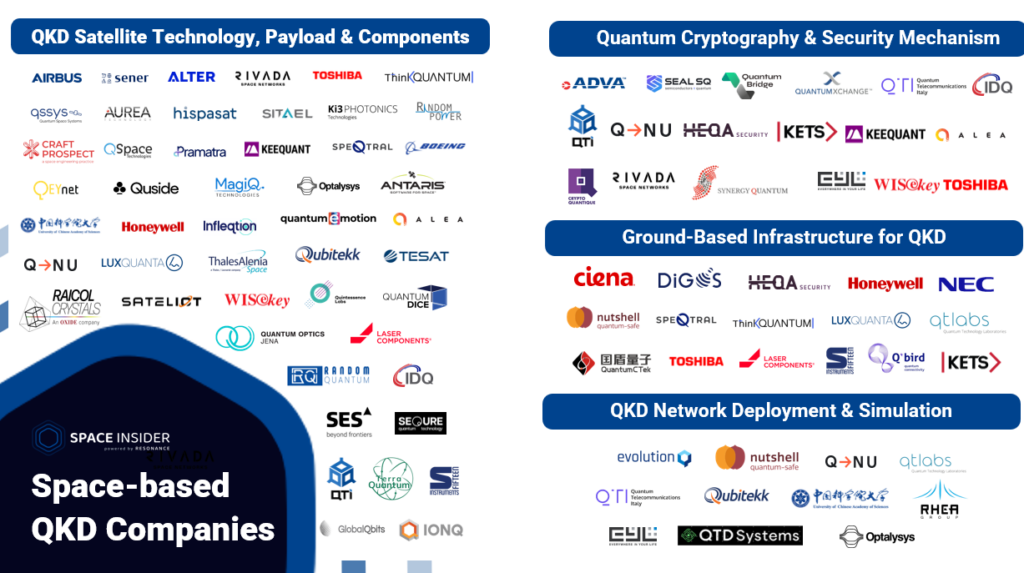
Space Insider Market Map Overview
Collectively, these Top 10 players and emerging programs represent the core ecosystem shaping the evolution of space-based QKD. As outlined in Space Insider’s latest Space QKD Market Map, this landscape spans satellite payload developers, ground-segment QKD integrators, optical terminal specialists, and early commercial constellation operators—together forming the technological and strategic foundation for quantum-secure global communications.
Outlook
Space-based QKD is transitioning from academic demonstration to national infrastructure. China’s operational systems provide a real-world benchmark, Europe is building sovereign capability through EAGLE-1 and QKD-GEO, and North America is accelerating development via Honeywell, Boeing, IonQ, and defense-driven research programs.
While broad commercial adoption before 2035 remains unlikely, the strategic value of QKD is now undeniable. The future of secure global communication will rely on a hybrid quantum-resilient architecture—uniting satellite QKD, terrestrial QKD networks, and post-quantum cryptography—to safeguard critical infrastructure, diplomatic channels, and global data flows in the quantum era.