

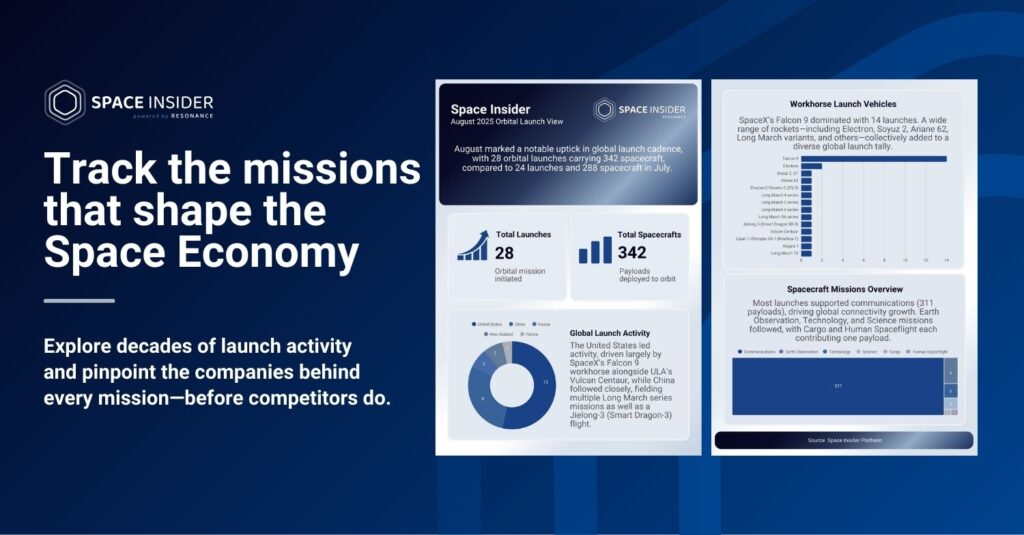
August 2025 saw another surge in orbital activity, with 28 launches deploying 342 spacecraft. This is an increase over July’s 24 launches and 288 spacecraft, showing an accelerating pace of deployment led by a handful of dominant players.
What drove launch activity?
The United States led the month with missions from SpaceX’s Falcon 9 and ULA’s Vulcan Centaur. China followed with a diverse manifest of Long March series flights as well as a Jielong-3 (Smart Dragon-3) launch. Russia and Europe contributed additional missions via Soyuz, Angara, and Ariane 62, while smaller commercial entrants such as LandSpace’s Zhuque-2 added to the tally.
Of the 342 spacecraft launched, 341 were deployed into Low Earth Orbit (LEO), cementing its status as the primary theater for orbital infrastructure. The lone exception was a U.S. Space Force payload sent to GEO aboard Vulcan Centaur.
Which constellations dominated satellite deployment?
Mega-constellations once again drove the month’s totals:
| Constellation | Satellites Deployed | Key Insight |
|---|---|---|
| Starlink | 216 | Nearly two-thirds of August’s spacecraft |
| Amazon Kuiper | 28 | Sustaining steady ramp-up |
| China SatNet | 18 | Reinforcing national broadband ambitions |
These deployments highlight the strategic contest to dominate global broadband markets through mass constellation growth.
Which sectors launched the most spacecraft?
Of the 342 spacecraft launched:
| Sector | Spacecraft | Meaning |
|---|---|---|
| Commercial | 287 | Strongest driver of orbital growth |
| Civil and Other | 42 | Stable contribution from science and government programs |
| Military | 13 | Slight increase from previous month |
The distribution reflects a widening commercial lead, with civil science and technology missions holding a steady share and a modest uptick in military payloads compared to July.
Why are these launch trends important?
August’s figures confirm the ongoing acceleration of commercial constellations as the central engine of orbital expansion. With deployment scaling into the hundreds each month, competitive dynamics are consolidating around a few powerful actors. Meanwhile, national and military programs continue to define strategic niches.
As the cadence of launches accelerates and new players enter orbit, understanding who is deploying, what is being launched, and why it matters is essential. Space Insider provides a recurring view into these shifts, giving you a clear line of sight into the forces defining the future of space.
Frequently Asked Questions
Why did spacecraft deployments increase in August 2025?
The rise from 288 spacecraft in July to 342 in August reflects higher launch cadence from major providers and steady demand from commercial constellation operators.
Which countries led launch activity this month?
The United States led through Falcon 9 and Vulcan Centaur missions, followed by China’s Long March and Jielong 3 launches, with additional contributions from Russia, Europe, and rising commercial players.
Why is Low Earth Orbit receiving nearly all spacecraft?
LEO remains the preferred destination because it supports broadband constellations, Earth observation missions, and low latency services while keeping launch costs lower compared to higher orbits.
What does the sector distribution tell us about market trends?
Commercial operators launched 287 spacecraft, showing they continue to drive most orbital growth, while civil and military missions maintain steady but smaller roles.
Why does monthly launch tracking matter?
It helps reveal which companies and nations are shaping global space infrastructure, where investment is accelerating, and how competitive dynamics are changing.