

Insider Brief:
- Space biotech represents a major untapped opportunity for pharmaceutical companies, leveraging microgravity environments to enable superior drug discovery, development, and manufacturing that is impossible to replicate in terrestrial labs
- Early case studies such as Merck’s reformulation of Keytruda and LambdaVision’s artificial retina show commercially relevant gains, including potential multi-billion-dollar patent extensions, healthcare system savings, and premium product markets.
- Despite clear scientific and economic potential, pharma investment in space biotech remains limited due to low awareness in terms of ROI and technical challenges, outdated cost assumptions, regulatory uncertainty, and general cultural inertia within R&D teams.
- Falling launch costs, proven orbital manufacturing missions, and the competitive advantage of reformulated drugs are creating strong incentives for early movers, positioning space biotech as a near-term opportunity for significant revenue and market share gains.
The pharmaceutical industry has a major opportunity that it may as of yet be largely unaware of. While traditional drug development remains mired in decade-long timelines, billion-dollar budgets, and staggering failure rates exceeding 90%, an opportunity is quietly taking shape 400 kilometers above Earth. Microgravity environments, a core part of space biotechnology, are enabling drug discovery, development, and manufacturing in ways that could deliver tangible commercial returns and potentially redefine how we create life-saving therapeutics.
How Is Space Biotech Moving from Science Experiments to Commercial Proof Points?
Early experiments in microgravity are already producing commercially relevant results that Earth-based labs cannot replicate. In space biotech, gravity-driven effects such as convection currents, fluid movement caused by temperature differences, and sedimentation disappear, allowing proteins and other molecules to assemble with unprecedented precision. This is especially valuable for protein crystallization, where uniform crystal structures can improve a drug’s stability, delivery method, and efficacy.
Case Study: How Does Microgravity Give Keytruda a Competitive Advantage?
Merck’s reformulation research for Keytruda underscores how microgravity can directly enhance high-value drugs. Crystallization studies aboard the International Space Station (ISS) produced uniform 39-micrometer particles, compared with Earth’s irregular 13–102 micrometer range. This uniformity could lead to improvements in drug formulation, manufacturing efficiency, and delivery.
- Commercial Impact: Keytruda generated $29.5B in 2024 (46% of Merck’s total revenue). Even modest gains from microgravity-enabled improvements could translate to hundreds of millions in added value annually.
- Patent Extension Potential: Reformulating Keytruda for subcutaneous (under-the-skin) delivery could extend market exclusivity post-2028 patent expiry, potentially adding $10–15B in revenue based on historical extension trends.
- Healthcare System Savings: Subcutaneous administration can reduce treatment costs by 50–71% versus intravenous (IV) infusion. If just 20% of Keytruda’s patients switched to subcutaneous delivery, system savings could exceed $3B per year while improving patient convenience.
Case Study: How Is LambdaVision Using Microgravity to Build an Artificial Retina?
LambdaVision is developing an artificial retina in microgravity to treat degenerative eye diseases affecting over 50M people worldwide. NASA’s $5M investment supports production of ultra-uniform retinal devices, a precision achievable only without gravity’s interference. Market projections place the artificial retina opportunity at $2–4B annually, with space-manufactured devices commanding premium pricing.
How Do Disease Models and 3D Bioprinting Extend Space Biotech Beyond Drugs?
Space biotechnology is also transforming preclinical research in ways that could directly impact drug development pipelines. In orbit, researchers are using organoids, miniature, organ-like structures, along with tissue chips and stem-cell-derived models to more accurately replicate human biology than is possible on Earth. This improved fidelity allows scientists to study disease mechanisms and screen potential therapies with greater predictive power, potentially reducing costly late-stage failures. Meanwhile, Redwire’s BioFabrication Facility (BFF) aboard the International Space Station has achieved a series of firsts in 3D bioprinting, including the creation of a viable human heart muscle patch and the first human knee meniscus in space. Such advances could lead to regenerative treatments targeting sports injuries, cardiovascular disease, and other conditions–all applications with global healthcare markets worth billions of dollars.
Why are Investments in Space Biotech Still Minimal?
Despite clear scientific promise and falling costs, pharmaceutical investment in space biotech remains minimal. Fewer than ten dedicated (“pure play”) space biotech R&D companies have raised more than $1 million in funding, which is a striking contrast to the $65 billion invested in biotech more broadly in recent years.
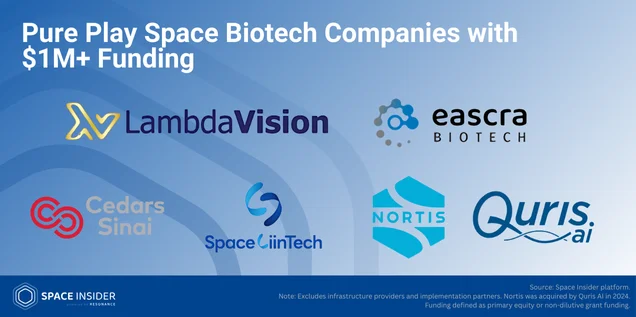
Source: Space Insider platform. Note: Excludes infrastructure providers and implementation partners. Nortis was acquired by Quris AI in 2024. Funding defined as primary equity or non-dilutive grant funding.
Awareness remains extremely low. Many executives still view microgravity research as a niche for space exploration rather than a tool for improving protein crystallization, disease modeling, or biomanufacturing. Existing space biotech data has not yet been sufficiently published in high-impact journals or structured to show clear pathways to clinical applications. So the first step is education of the pharmaceutical community: outlining ROI and an understandable narrative that helps “make the case for space” versus Pharma’s other strategic priorities (e.g. AI/ML, Quantum).
Economics are often misjudged, with outdated assumptions about launch costs and availability; with SpaceX’s reusable rocket, mission costs drop from $12 million initially to a projected $2.5 million or less by the tenth mission. Automated platforms reduce risk of human error, crew dependency, scalability and throughput limitations, human involvement complicating QA and audit trails, and ultimately costs (an astronaut costs ~$130k per hour).
Practical challenges remain, including limited ISS access, the need for specialized hardware, and regulatory uncertainty as the FDA has yet to establish formal guidelines for space-manufactured drugs, creating regulatory uncertainty that risk-averse pharmaceutical companies find difficult to navigate. Space-based CROs (like Exobiosphere) may be able to play an enabling role alleviating these challenges.
Above all, the pharma industry’s inherent conservatism, shaped by longstanding regulatory rigor and high development costs, makes leaders hesitant to embrace paradigm-shifting approaches over incremental improvements. As of today, the sector is still largely propelled forward by passionate and visionary individuals.
What Catalysts Will Accelerate Space Biotech Adoption?
That hesitation may not last much longer. Patent extension economics are one of the clearest incentives: blockbuster drugs earn an average of 56% of their lifetime revenue during exclusivity extensions, and microgravity reformulation can provide the performance gains needed to justify them. Proven missions are also building credibility. Varda Space Industries has already reformulated the HIV drug ritonavir in orbit, with the company’s recent $187 million Series C funding round signaling investor confidence in the team’s capability to execute on pharmaceutical interest. Meanwhile, Starfall is preparing to use SpaceX’s Starship for large-scale manufacturing by the decade’s end.
Better formulating the ROI of Space Biotech is a critical lever. As one pharmaceutical executive describes the commercial calculus: “If we reformulate the drug better and if our drug is a subcutaneous injection through an injection pen and the competitor is an infusion, then instead of 50% market share, we’re going to have maybe 80% market share. So that changes our calculation of future sales, and we calculate the NPV of that investment. So we have to invest, let’s say, $10 million in this research to reformulate. And the extra market share in the future is going to give us, $2 billion.”
This same logic applies directly to space-enabled reformulations. If microgravity can deliver the performance gains needed to shift market share, the investment case becomes clear. A single reformulation that shifts delivery from infusion to injection could capture tens of percentage points in market share, translating to billions in additional revenue. Meanwhile, launch and manufacturing costs are set to fall further as competition grows among commercial space providers, and regulatory pathways are beginning to take shape through NASA partnerships and early IND filings citing space-generated data. As companies like Merck publish successful microgravity results, competitive pressure will mount, pushing late adopters to act or risk losing ground in drug development capabilities. Data from Space Biotech has the potential to be a source of unique data for AI applications – critical when positioning the sector within Pharma’s broader strategic priorities.
| Catalyst | Description | Strategic Impact |
|---|---|---|
| Patent extension economics | Unique space-generated data can feed proprietary AI models | Microgravity reformulation can justify new exclusivity periods |
| Proven orbital missions | Examples such as ritonavir reformulation build technical and investor credibility | Reduces perceived risk for pharma partners |
| Falling launch and production costs | Reusable systems and new vehicles lower mission cost and increase capacity | Blockbuster drugs can earn about 56 percent of their lifetime revenue during extensions |
| Regulatory and data pathways | Early filings and NASA partnerships begin to define accepted processes | Makes compliance and approval feel more predictable |
| AI and data differentiation | Unique space generated data can feed proprietary AI models | Makes space-based manufacturing financially attractive |
What Is the Path Forward for Industry Leaders in Space Biotech?
The space biotech opportunity now demands decisive action from both sides of the ecosystem.
For space biotech companies, the priority is to move beyond scientific novelty and speak the language of the boardroom. That means presenting hard ROI and NPV calculations, quantifying patent extension value, and mapping clear pathways from microgravity experiments to repeatable, revenue-generating missions. This sector needs more validated case studies, and fewer speculative promises, to win sustained industry investment.
For pharmaceutical companies, the challenge is equally urgent. Leadership teams must be educated on the tangible benefits of microgravity research, from drug reformulation to delivery innovation. Dedicated exploration programs, early partnerships with proven space biotech players, and internal capability-building will be essential to avoid ceding first-mover advantage.
The debate is no longer about whether space biotech will shape the future of drug development; the real question is which companies will lead that future, and which will be forced to follow the early pioneers who recognized the opportunity before the rest of the industry could see past the science fiction label. In a market where a single drug can generate tens of billions in annual revenue, the microgravity advantage is a competitive edge.
At Space Insider, we are actively working to build this emerging sector. If you are a scientist or pharmaceutical executive exploring the benefits of space-based R&D-or a space company seeking to connect with the pharmaceutical industry-reach out to us at [email protected]. We can advise, share market insights, and connect you with our partners across Europe and North America who are shaping the future of space biotech.
Frequently Asked Questions
What is space biotech in simple terms?
Space biotech is the use of microgravity and orbital platforms to discover, develop, and manufacture drugs and medical products in ways that are not possible in normal gravity on Earth.
Why should pharmaceutical companies care about space biotech now?
Pharmaceutical companies should care now because launch costs are falling, early missions have already shown commercial impact, and microgravity reformulation can support patent extensions, premium pricing, and improved delivery routes.
Is space biotech only relevant for a few flagship drugs?
No, although examples such as Keytruda are highly visible, the same principles apply to many biologics, complex formulations, and regenerative therapies where structure and uniformity matter.
Is space biotech too expensive for realistic return on investment?
New launch economics, automation, and targeted mission design mean that costs can be small compared with the value of even a modest increase in revenue or market share for a leading therapy.
How can a pharma company start exploring space biotech?
A practical first step is to identify one or two high-value assets where improved formulation or delivery would be transformative, then work with a space biotech partner or space-focused CRO to design a focused microgravity experiment and build a clear business case around the results.