
Insider Brief
- China has launched the world’s first space computing constellation, deploying 12 AI-equipped satellites into orbit aboard a Long March 2D rocket on May 14.
- Developed under the “Star Computing” initiative by Guoxing Aerospace and Zhijiang Laboratory, the satellites offer a combined 5 POPS of onboard computing power with inter-satellite laser links at 100 Gbps.
- The constellation is designed to perform in-orbit AI processing, support real-time Earth observation, and serve as the backbone of a future global space-based computing infrastructure.
China has started building a space super computer constellation with the launch of a dozen AI-equipped satellites, the first of a planned several thousand.
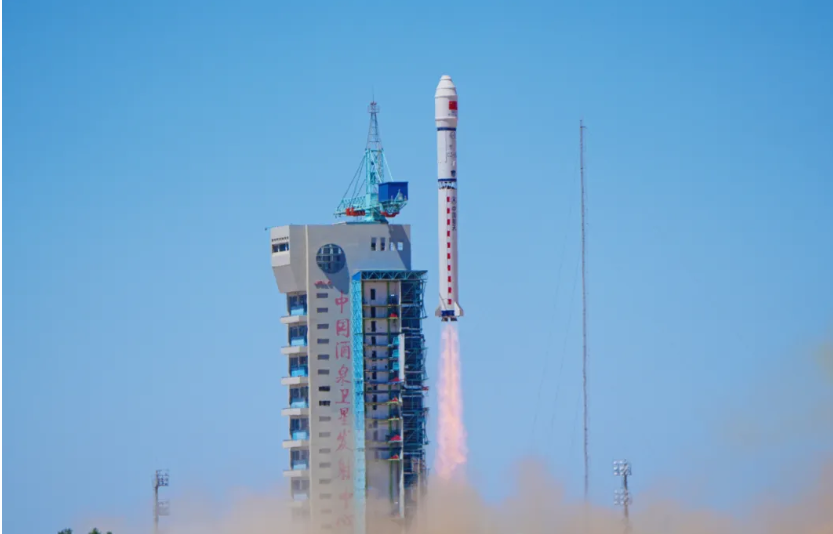
On May 14, a Long March 2D rocket lifted off from the Jiuquan Satellite Launch Center, deploying 12 networked satellites developed by Guoxing Aerospace, also known as ADA Space, and Zhijiang Laboratory, according to Guoxing Aerospace and the state-owned China Aerospace Science and Technology Corporation. The mission, codenamed 021, which stands for 0 to 1, is the initial phase of the “Star Computing” program.
Unlike traditional satellites that downlink raw data to Earth for processing, these AI-enabled satellites are built to perform real-time data processing in orbit. Each satellite is equipped with up to 744 trillion operations per second (TOPS) of computing power. Together, the constellation delivers 5 peta operations per second (POPS), which when fully built would make it the most powerful orbital computing network ever deployed.

The constellation architecture includes high-speed inter-satellite laser communication links capable of transferring data at 100 gigabits per second. This allows for distributed computing across the network, enabling tasks like collaborative Earth observation, autonomous AI model training, and near-instant decision-making on scientific events such as gamma-ray bursts.
The satellites carry an AI-based astronomical time domain model and an X-ray polarimeter to detect and classify transient astrophysical events with near-instant reaction time. Officials say the platform enables “day-to-day” computing rather than “day-to-ground,” reflecting a shift in processing workloads from Earth to orbit.
The satellites also feature onboard digital twin generation, allowing them to create real-time 3D maps of Earth-based targets to support industries such as emergency response, urban planning, and remote tourism.
China has become a major player in the global space industry by building a state-backed, vertically integrated ecosystem that blends government support with a growing commercial sector. With over 500 entities—including state-owned enterprises, private firms, universities, and research institutes—China is advancing across launch services, satellite manufacturing, and space operations, all aligned with its geopolitical goals.
The Space Insider Market Intelligence Platform tracks this dynamic sector and now highlights 270 core organizations in its updated China Space Industry Market Map. The platform also identifies key technologies and investment trends. A newly published report, China’s Space Industry: A Strategic Overview, offers a comprehensive analysis of China’s space strategy, technical progress, and commercial developments across launch, satellite production, and capital flows.