
Insider Brief
- Germany-based Atmos Space Cargo is set to become the first private European firm to reenter Earth’s atmosphere with its PHOENIX 1 capsule, launching April 21 aboard SpaceX’s Bandwagon-3 rideshare mission.
- The capsule will test in-orbit systems, customer payload operations, and an inflatable heat shield during reentry, which now includes a riskier trajectory and an experimental airborne recon mission to reestablish data links during the blackout phase.
- Flight data from the mission will inform the development of PHOENIX 2, a more advanced capsule slated for 2026 with onboard propulsion and improved reentry control.
A small European aerospace startup is about to make history with a return from space.
Atmos Space Cargo, a German private space logistics company, is preparing for the debut flight of its PHOENIX 1 re-entry capsule, which is set to launch aboard SpaceX’s Bandwagon-3 rideshare mission scheduled for April 21. If successful, PHOENIX 1 would become the first privately operated European spacecraft to reenter Earth’s atmosphere, according to the company.
The capsule is designed to test a trio of key technologies: in-flight data collection from the capsule’s systems in low-Earth orbit, data acquisition from onboard scientific payloads, and the deployment of an inflatable heat shield during atmospheric reentry. The latter is crucial to protecting the capsule from searing reentry temperatures and is part of a wider strategy to enable low-cost return missions in the future.
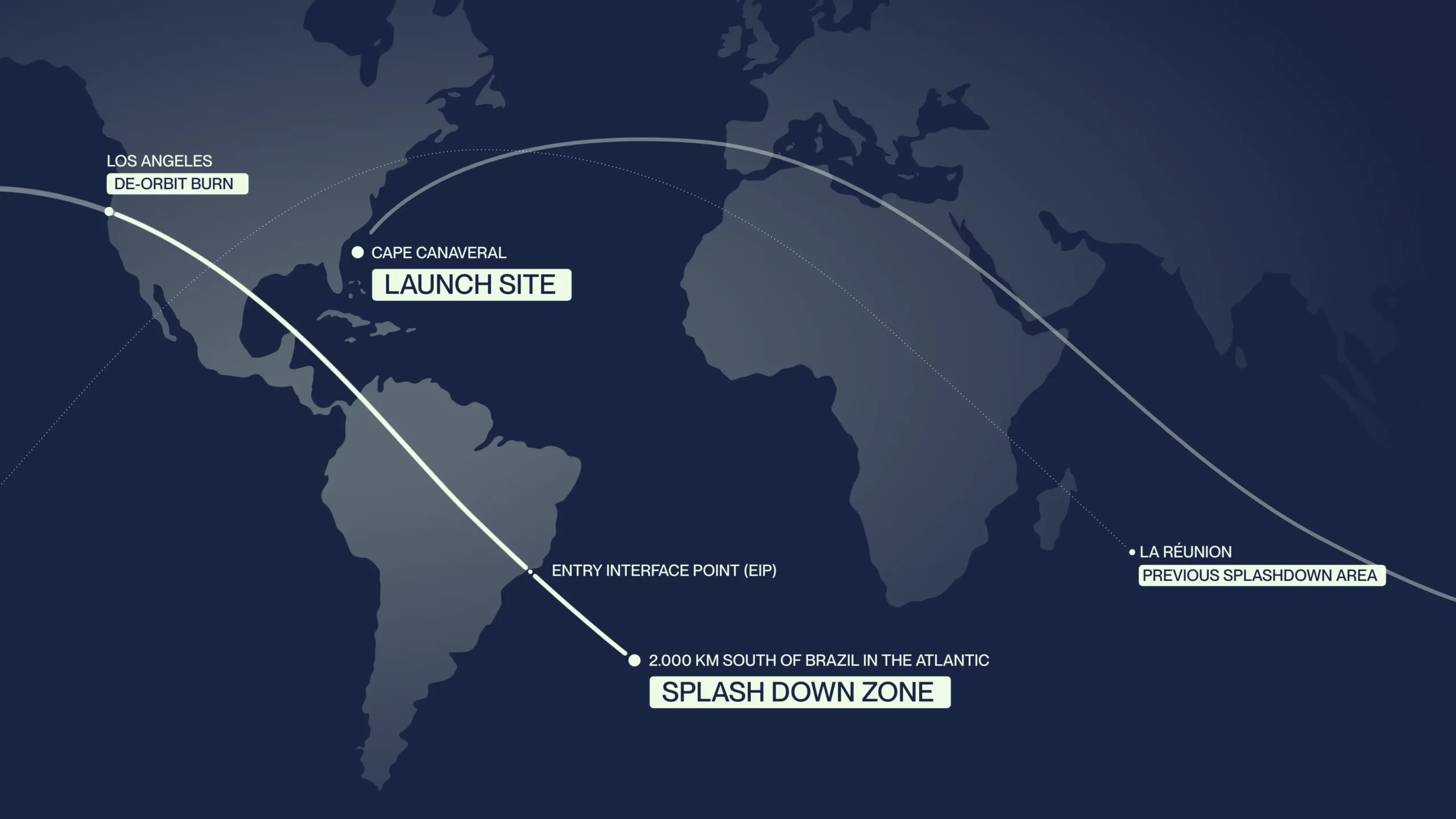
Originally, PHOENIX 1 was expected to follow a return path that would take it over Africa and the Indian Ocean. But recent mission updates forced a significant change. The new flight path takes the capsule on a westward arc over Los Angeles, across Colombia and Brazil, before splashing down in the Atlantic Ocean, roughly 2,000 kilometers off Brazil’s coast.
To support this revised trajectory, Atmos rapidly established new ground stations across the Americas to ensure continuous data downlink during the capsule’s descent. “Every day is becoming exciting for us here at Atmos,” the company stated in a release.
In an additional, last-minute change, the company introduced a high-risk, high-reward element: an experimental air-to-air reconnaissance operation to capture the capsule’s descent. Because traditional ground-based communication is likely to fail during the intense plasma blackout phase of reentry, Atmos is deploying a chase aircraft equipped with a satellite terminal to track the capsule from the point it hits the upper atmosphere to the ocean splashdown.
“In addition to these updated parameters, we are also expecting a steeper flight path angle, resulting in a higher vertical re-entry velocity, which introduces higher thermal and aerodynamic loads to our capsule’s re-entry scenario,” the company explained on its website. “Under these conditions, there is a high probability that the increased thermal stress and aerodynamic forces may affect the capsule structure and heat shield, but all flight data we will receive during this inaugural flight will inform our system analysis and optimization for PHOENIX 2.”
The company plans to launch PHOENIX 2 in 2026. That capsule will include its own propulsion system, enabling the team to control reentry timing and location more precisely.
The company has also announced Stuttgart-based venture capital firm Mätch VC has invested a €1 million in its business.
“ATMOS exemplifies what we look for: bold teams building key technologies for Europe’s future competitiveness. Access to space logistics is not optional – it’s foundational for future industrial growth,” Alina Biermann, Partner at Mätch VC, said in a statement.
The Bandwagon-3 launch is scheduled for April 21 at 8:48 p.m. EST from Cape Canaveral Space Force Station, according to SpaceX. A backup window is available the following evening. The launch webcast will be streamed live on SpaceX platforms and the new X TV app. It will be SpaceX’s third launch in the past two days.
Other payloads aboard Bandwagon-3 include ADD’s 425Sat-3 and Tomorrow Companies Inc.’s Tomorrow-S7, according to SpaceX. The Falcon 9 booster used for this mission has previously flown two times and will attempt a landing at Cape Canaveral’s Landing Zone 2 after stage separation.