Insider Brief
- China is accelerating the development of Thailand’s space industry through technology transfers, joint satellite missions, and talent development initiatives.
- Thailand’s GISTDA is working with over 10 Chinese organizations on projects ranging from satellite manufacturing to participation in China’s lunar exploration missions.
- Educational and research exchanges, including a joint master’s program with Wuhan University, are helping to train the next generation of Thai aerospace professionals.
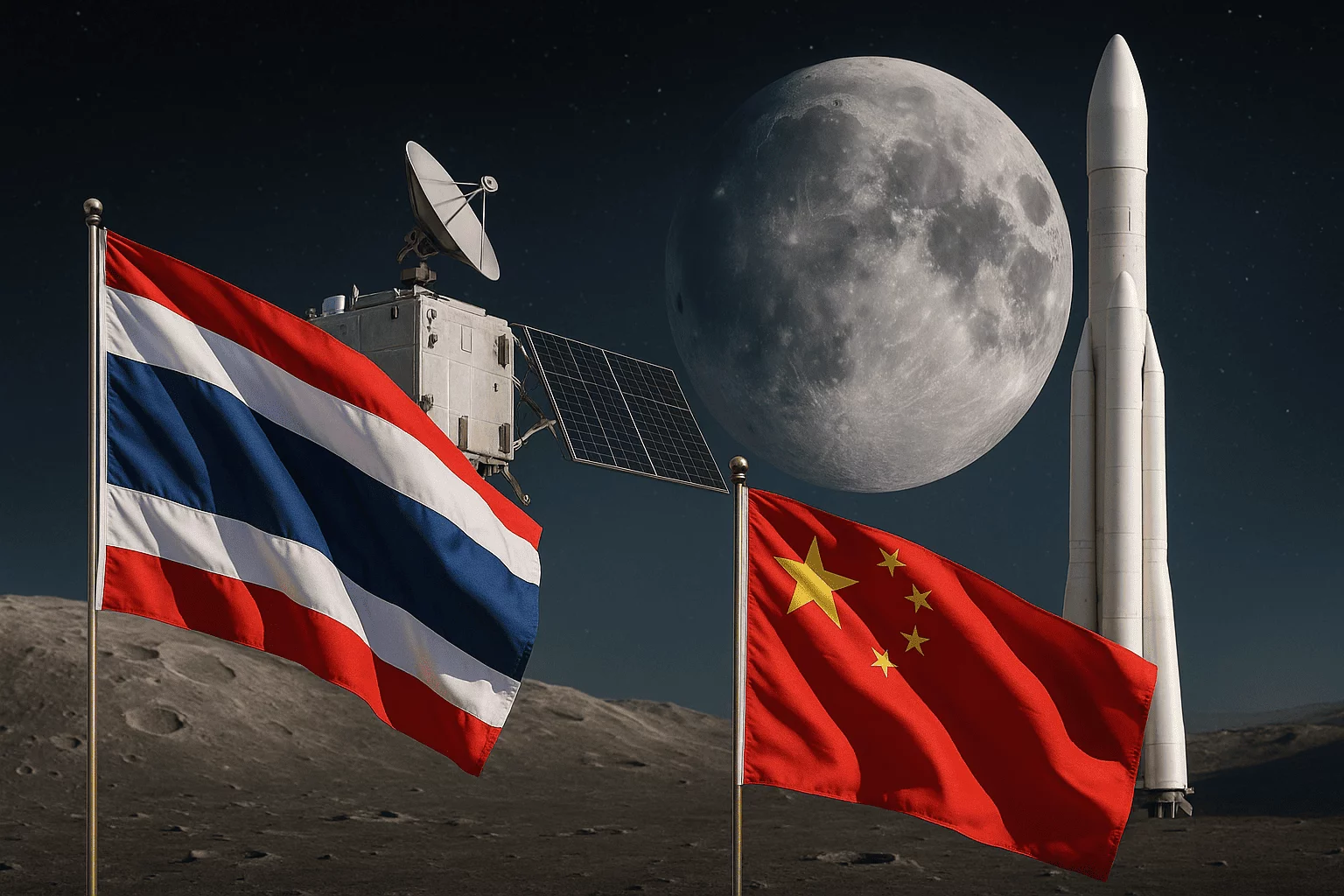
China is deepening its role as a key partner in Thailand’s expanding space program, recent news report suggests. The collaboration is delivering both equipment and expertise that are accelerating Thailand’s aerospace ambitions.
The cooperation spans research, satellite development, lunar missions, and education programs, according to reports. Chinese-built testing equipment now sits inside Thailand’s Space Krenovation Park in Sriracha, Chonburi Province—roughly two hours southeast of Bangkok—where institutions like the Geo-Informatics and Space Technology Development Agency (GISTDA) operate satellite development labs and control rooms, Xinhua reports. Xinhua is China’s official state-run news agency and serves as a primary outlet for the Chinese government’s communications and perspectives.
The news service reports these initiatives reflect growing cross-border ties in space exploration and technology.
“Thanks for China’s support for Thailand in the space technology field, the cooperation with China has promoted the rapid development of Thailand’s space industry,” said Atipat Wattanuntachai, mechanical lead engineer at Geo-Informatics and Space Technology Development Agency (GISTDA).
Vibration Testing Equipment
Thailand’s current centerpiece satellite is THEOS-2 — Thailand Earth Observation System-2, a low-earth orbit satellite for Earth observation. Chinese-manufactured vibration testing equipment is used to assess its performance and launch readiness, according to Xinhua. The equipment is one of several infrastructure contributions made by China to boost Thailand’s space capabilities.
GISTDA, which reports to Thailand’s Ministry of Higher Education, Science, Research and Innovation, is spearheading this modernization. The agency is tasked with developing Thailand’s aerospace programs and geographic information technologies, including satellite-based remote sensing services.
China has become a central partner in that mission, according to XInhua.
China is an important partner in the fields of Thailand’s aerospace technology and geographic information, said Phee Choosri, deputy executive director of GISTDA, in the interview with Xinhua. He added that the GISTDA has collaborated with more than 10 Chinese organizations in these fields. These collaborations ranged from applied research to upstream industries and even space exploration.
International Lunar Research Station
The cooperation goes beyond satellites and ground systems. Last year, China and Thailand signed two formal agreements — known as memorandums of understanding — to strengthen collaboration on the peaceful use of outer space and on a planned international lunar research station. Thailand also hosted its first exhibit of lunar samples from China’s Chang’e-5 mission in July 2024. According to Xinhua, the event drew large crowds, demonstrating rising domestic interest in space exploration.
As further evidence of the growing cooperation. Thailand will send a space weather monitoring payload aboard China’s Chang’e-7 lunar mission. The instrument will measure cosmic radiation and other space weather from the Moon’s surface, providing valuable data for long-term lunar operations.
“Space exploration is a mission that Thailand attaches great importance to,” said Phee. “And the cooperation with China in Chang’e mission provides Thailand with the opportunity to get involved in high-tech projects, promoting the development of Thai space technology, and cultivating Thai talents in the fields of aerospace technology.”
Space Seeding
China’s collaboration with Thailand also supports more novel research initiatives. In October 2024, China retrieved its first reusable satellite, Shijian-19, which carried international payloads — including one from Thailand. The Thai experiment involved sending local rice seeds into orbit to test how they respond to space conditions, a move intended to explore crops resilient to extreme environments.
Phee said that seeding programs like this one serve dual purposes: enhancing national food security and laying the groundwork for participation in the emerging space economy.
The countries are also collaborating on talent developmen, a recurring theme in the partnership. Thailand’s GISTDA and China’s Wuhan University co-launched a graduate program in geographic information science, aimed at building the next generation of specialists in satellite data and analysis. Thailand is also a member of the Beijing-based Asia-Pacific Space Cooperation Organization (APSCO), which hosts regular exchanges on satellite design and space engineering across the region.
Atipat emphasized the impact these exchanges are having on Thai youth. “The greatest beneficiaries of these projects are the young generation who have space dreams,” he said. “Through cooperation and exchanges or further studies in China, these young Thai people have learned cutting-edge technologies in the aerospace field, further igniting their space dreams.”
From satellite manufacturing to moon-bound payloads, China is supplying the tools, platforms, and programs that Thailand needs to join the space economy. Whether these efforts will give Thailand a lasting presence in the commercial or scientific space sectors remains to be seen. But Thai officials are optimistic.
“China is one of the world’s leading aerospace powers and an important promoter of the global space economy and industry,” said Phee. “Deepening cooperation with China in the aerospace field will bring many important opportunities and benefits to Thailand.”
He added that Thailand hopes to one day compete globally in space technology and secure a place in the evolving space economy.