
Insider Brief
- A NASA study found that bone loss in space affects only weight-bearing bones and is caused by lack of gravity-related stress, not radiation or other systemic factors.
- Mice flown on the ISS for 37 days lost significant bone mass in the thigh bone but not the spine, highlighting the role of physical loading in bone health.
- Ground-based mice housed in activity-promoting cages maintained bone mass, suggesting that movement and mechanical strain are critical to preserving bone strength in space and on Earth.
A NASA study has found that bone loss in space is largely limited to weight-bearing parts of the skeleton and is primarily caused by mechanical unloading in microgravity — not by radiation or other systemic stresses.
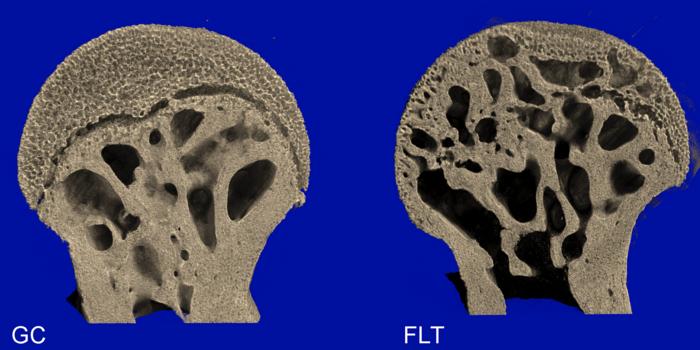
Published in PLOS ONE, the study examined mice flown aboard the International Space Station (ISS) for 37 days. Using high-resolution bone scans and tissue analysis, researchers observed significant bone loss in the femur — a major weight-bearing bone — but not in the spine. According to the study, this site-specific pattern points to gravity-related mechanical loading, rather than systemic spaceflight factors, as the primary driver of skeletal deterioration in orbit.
“The lack of bone degenerative effects in the spine in combination with same-animal paired losses in the femur suggests that space radiation levels in Low Earth Orbit or other systemic stresses are not likely to significantly contribute to the observed bone loss,” the researchers report.
Study Could Inform Long-Duration Missions
The findings matter as space agencies and private firms ramp up efforts for long-duration missions to the Moon and Mars. Bone loss has long been a known issue in microgravity, but its root causes have remained under debate. By isolating the mechanical effects of weightlessness from radiation and other physiological stressors, the study offers clearer direction for countermeasures.
The study used microcomputed tomography, or micro-CT, and histological analysis — or microscopic analysis of tissue — on bone samples from mice flown in NASA’s Rodent Research-1 (RR-1) mission, which took place in Low Earth Orbit (LEO). Mice were launched at 16 weeks of age and lived in NASA’s upgraded Rodent Habitat aboard the ISS for over a month. Their bones were compared with those of ground-based controls kept either in standard cages or in the same Rodent Habitat, simulating spaceflight conditions without weightlessness.
Among the key results: mice that spent time in space lost substantial bone mass in the top of the thigh bone — or femoral head — and lower end of the thigh bone — or distal femur. Bone volume fraction (BV/TV), a measure of healthy bone density, dropped by 25%–55% in these regions. Trabecular thickness, number, and spacing—all structural features of bone — also worsened. By contrast, no statistically significant bone changes were seen in the L2 vertebra, a region primarily loaded by muscle tension in animals that walk on four legs.
To test whether these changes could be attributed to radiation, the team looked at exposure levels during the 37-day spaceflight. The cumulative dose measured was about 7.4 milligray — orders of magnitude lower than levels shown to cause bone damage in ground-based radiation studies. The spine, which should have been equally or more vulnerable to radiation effects given its thin cortical shell, showed no comparable deterioration.
Importance of Movement And Exercise
The study also found that the mice housed in the Rodent Habitat on the ground — without exposure to microgravity — maintained or even gained bone mass compared to those in standard cages. This suggests that enriched environments promoting movement, such as climbing on wire mesh surfaces, can help preserve bone density. Standard cage-housed mice, by contrast, showed early signs of bone loss even without going to space.
This supports the idea that even on Earth, mechanical loading — which is just the pressure or strain from movement — plays a major role in maintaining bone integrity, according to the researchers.
Beyond bone loss, the researchers also uncovered a surprising developmental shift in the space-exposed mice. The femoral head of mice flown in space showed signs of accelerated secondary endochondral ossification — a process that signals the end of bone growth. In essence, the space environment appeared to trigger premature maturation of skeletal structures. That could raise concerns for future long-duration missions involving juvenile animals or potentially even humans still undergoing skeletal development.
The study controlled for confounding factors by using a mix of baseline (pre-flight), cage-housed, and habitat-matched ground controls. Each mouse’s femur and vertebrae were analyzed from the same animal to enable direct within-subject comparison. The researchers used standard statistical methods, including one-way ANOVA and paired t-tests, to confirm the significance of their findings.
Follow-up Studies Needed
Limitations of the study include its focus on female mice nearing skeletal maturity and the relatively short duration of the mission. While the results strongly suggest weightlessness is the dominant factor for bone loss in LEO, the authors acknowledge that higher doses of space radiation — such as those encountered beyond Earth’s magnetic field on Moon or Mars missions — may still have skeletal effects. The mechanisms behind accelerated bone maturation in space remain unclear and warrant further investigation.
The authors recommend follow-up studies with longer-duration flights, different ages and sexes of animals, and conditions simulating deep space radiation. Such work will be essential to understanding the full risks of long-term space habitation.