
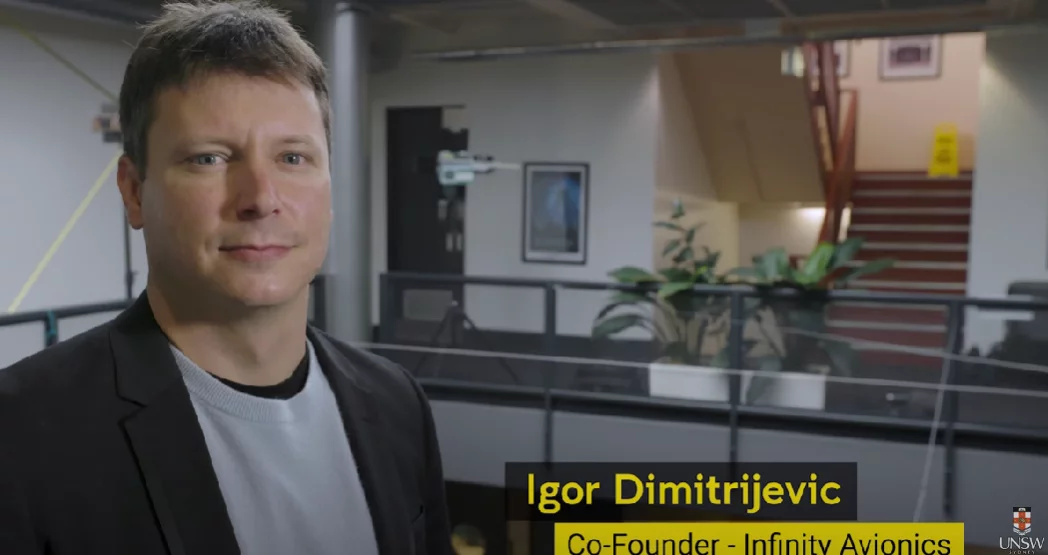
Everybody likes a business success story. And that is certainly the case with Infinity Avionics. Founded in 2020 by CEO Igor Dimitrijevic and COO Damith Abeywardana, Infinity Avionics is a UNSW Canberra spinoff whose goal is to provide flexible and reconfigurable electronic subsystems in a small form factor to support complex nano-satellite missions.
The company’s precision-engineered space products, including high-resolution Earth observation cameras, provide detailed images of the planet’s surface from space. A wide range of applications, including environmental monitoring, disaster response, urban planning and disaster recovery, are possible with these cameras, as they use advanced optics and electronics.
Space Startup of the Year
By focusing on cutting-edge research and hard work, Infinity Avionics has all the tools in the shed to meet the growing demand for high-quality Earth observation data, which is becoming crucial for different industries and applications. As a result of its unique approach, the company has been recognized and has won numerous awards, including the Australian Space Startup of the Year.
This month, the head of Infinity Avionics, Igor Dimitrijevic was the focus of a short film produced by UNSW.
“The space industry is the pinnacle of engineering,” said Dimitrijevic. “It demands extreme rigour but also creativity. Devices and instruments going to space have to be engineered in a certain way to be reliable because these devices, once launched, cannot be fixed or repaired anymore so we have to guarantee that they will work for their designed lifetime.”
With over ten years of experience as an electronics design engineer, Dimitrijevic has mostly been engaged with the aerospace industry, working on hypersonic sounding rocket payloads, as well as hardware development and spacecraft mission planning.
“I came to work at UNSW as the electronic spacecraft lead to work on some amazing projects launching five spacecraft to orbit,” he continued, adding that over the years the technology developed at UNSW had commercial value.
“This is where the idea of spinning out the company and commercializing these technologies was born,” said Dimitrijevic.
Dimitrijevic — who was Spacecraft Electronics Lead Engineer at UNSW Canberra for four years — admits that starting a company presents many challenges.
Edge of Your Comfort Zone
“We had to learn quick,” he said. “UNSW provides a very good framework to contact the right people, to get their guidance and to follow very precise steps. When you operate at the edge of your comfort zone and push those boundaries, that’s where you’re achieving something.”
And with the global satellite Earth observation market size valued at US $7,705.9 million in 2021 and a predicted rise of US $13,672.7 million by 2030, increasing at a CAGR of 6.92% from 2022 to 2030, according to Straits Research, Dimitrijevic and Infinity Avionics are in a very good position.
If you found this article to be informative, you can explore more current space news, exclusives, interviews and podcasts here.
SOURCE: UNSW
Featured image: ‘Infinity Avionics: From UNSW Research to Australian Space Startup of the Year and Beyond.’ Credit: UNSW