Insider Brief
- Mitsubishi Electric, Fujitsu, Satellite Data Services, and Japan’s National Research Institute for Earth Science and Disaster Resilience (NIED) have signed a joint research agreement to develop the Japan Disaster Charter, a new framework for satellite-based disaster response.
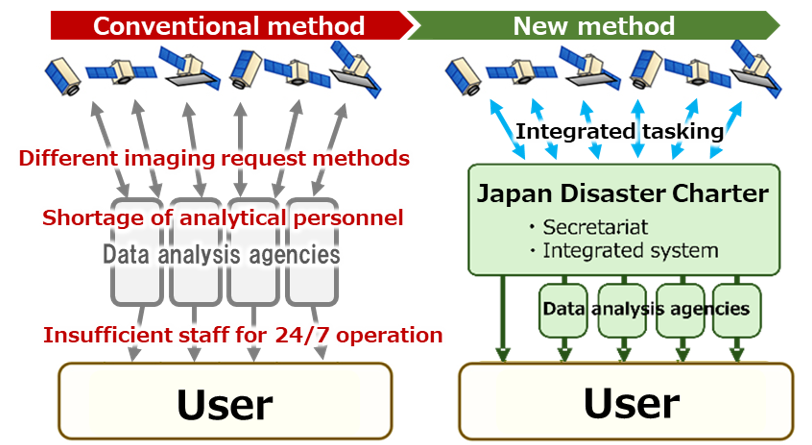
- The agreement aims to enhance rapid data delivery, strengthen automated satellite tasking, and build a one-stop data system to support disaster-response agencies, local governments, and public institutions with high-resolution satellite imagery.
- Scheduled to launch demonstration services by fiscal year 2026, the system integrates public-private capabilities for faster damage assessment, reconstruction monitoring, and secondary disaster prevention, marking a major step toward real-time, satellite-powered emergency management in Japan.
Japan is advancing a new satellite-based disaster response system that could transform how quickly and effectively authorities react to earthquakes, floods, and other natural catastrophes.
Under a joint research agreement announced May 22, the National Research Institute for Earth Science and Disaster Resilience (NIED), Fujitsu, Satellite Data Service Co., Ltd. (SDS), and Mitsubishi Electric will work together to operationalize the Japan Disaster Charter—a satellite-driven framework intended to support emergency responders, local governments and others with rapid, high-resolution data in the critical hours after a disaster.
According to the joint announcement, the system will leverage Earth observation satellites to provide comprehensive overviews of disaster zones. While satellites are already used for monitoring, the new effort focuses on speed and automation. The goal is to minimize the time between a disaster and the delivery of actionable satellite-derived information to emergency personnel.
A key feature is the “Satellite One-Stop System,” designed to automate satellite tasking and data delivery. When activated, it identifies available satellites, directs them to observe disaster-hit areas, and delivers analysis-ready imagery. The aim is to cut manual processes and reduce response times.
The initiative also includes developing technologies for scheduled repeat observations, enabling officials to monitor recovery progress and identify secondary risks such as landslides or liquefaction, the organizations noted in the announcement. The partners will explore public-private business models and expand common data analysis tools to increase the system’s scalability.
Joint Research Roles and Responsibilities (May 15, 2025 – March 31, 2026)
- NIED will plan and coordinate drills and demonstrations with end-users, implement scenarios based on actual disaster events, and lead efforts in social implementation of research outcomes.
- Fujitsu will upgrade the Satellite One-Stop System and provide operational support during drills and actual disaster demonstrations.
- SDS will develop and verify an automated platform for satellite tasking and data integration, and lead enhancement of secretariat functions from a private sector perspective.
- Mitsubishi Electric will strengthen common satellite-data analysis functions, support demonstration activities, and explore and evaluate a public-private business model.
The work builds on Japan’s BRIDGE program, which supports applying R&D to real-world challenges. The partnership expects to launch demonstration services by the end of fiscal 2026 and gradually expand to 24/7 operations.
The research aims to move satellite disaster intelligence from bespoke analysis to a standardized, fast-response service—broadening its use across local governments, emergency services, and the private sector.