
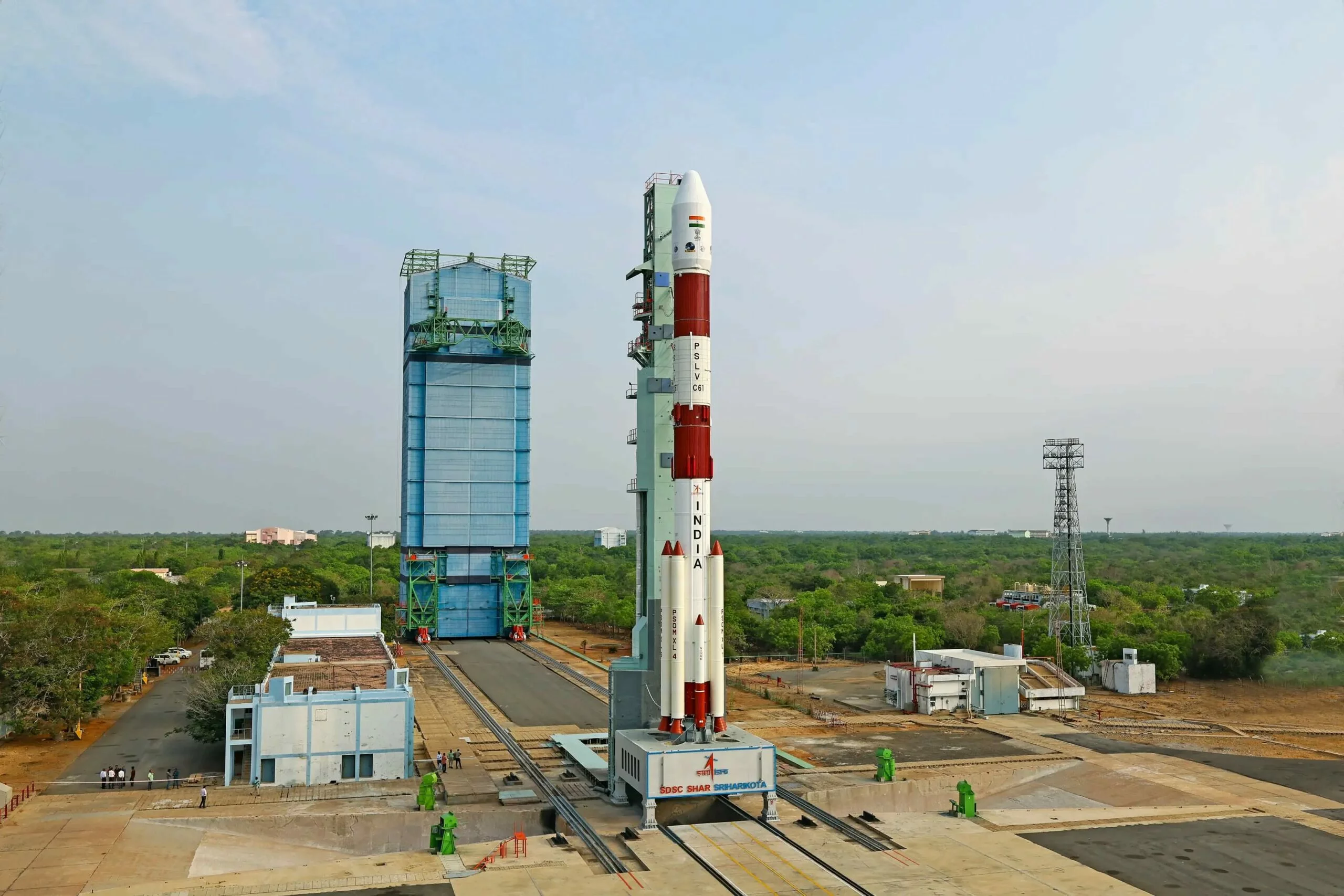
Insider Brief
- India’s PSLV-C61 mission failed to deploy its payload after a third-stage malfunction halted the launch of the EOS-09 Earth observation satellite.
- The Indian Space Research Organisation (ISRO) reported a drop in chamber pressure in the rocket’s third stage following a successful lift-off and first two stages, marking only the third failure in PSLV’s operational history since 1993.
- Despite the setback, a new study underscores the strategic role of India’s space sector in national economic development, projecting a fivefold growth in the space economy over the next decade.
India’s latest satellite mission suffered a setback early Sunday when the third stage of the Polar Satellite Launch Vehicle (PSLV-C61) malfunctioned, preventing the deployment of the Earth observation satellite EOS-09. The Indian Space Research Organisation (ISRO) confirmed the anomaly after a smooth lift-off from the Satish Dhawan Space Centre in Sriharikota.
The PSLV, a four-stage launch vehicle, performed as expected through its first two stages, ISRO Chairman V. Narayanan said after the attempt. However, ISRO Chairman reported a drop in chamber pressure in the solid-fuel third stage, disrupting the rocket’s trajectory and halting the mission. EOS-09, a 1,696-kilogram satellite equipped with a Synthetic Aperture Radar payload, was designed for high-resolution imaging under all weather conditions, including at night.
“The PSLV is a four stage vehicle. Up to the second stage, the performance was quite normal,” Narayanan explained in a televised statement. “Third stage, motor started perfectly, but during the functioning of the third stage, we are seeing a observation, and the mission could not be accomplished. After analysis, we shall come back.”
The failure marked only the third instance of a PSLV malfunction since its debut in 1993, underscoring the rocket’s otherwise consistent track record, The Economic Times reported. The PSLV-C61 mission, India’s 101st space mission, was the vehicle’s 63rd flight and the 27th using the extended XL configuration. A Failure Analysis Committee (FAC) will now investigate the malfunction, according to the . The panel will include senior ISRO engineers and external experts and is expected to examine flight data, launch preparations, and subsystem performance.
ISRO is expected to release a detailed technical assessment following the FAC’s review.
India’s space sector is emerging as a quiet force behind the country’s economic transformation, according to a new study by researchers from Trivandrum, Ahmedabad University, NIAS, and the Indian Institute of Space Science and Technology. The report finds that beyond satellite launches, the industry is creating jobs, driving innovation, and expanding digital access to underserved regions. Using more than a decade of data and a structured impact framework, the researchers estimate the sector directly employs around 22,000 people and generates over ₹2,940 crore ($354 million) annually through ISRO’s commercial arm, NSIL. If current growth trends hold, the study projects India’s space economy could expand fivefold over the next decade.