
Insider Brief
- NASA has selected SpaceX to launch the Pandora mission, which will study how stellar variability affects exoplanet atmosphere observations by focusing on at least 20 known exoplanets and their host stars.
- The mission is part of NASA’s Venture-Class Acquisition of Dedicated and Rideshare (VADR) launch services contract, a fixed-price program allowing awards over a five-year period with a total maximum value of $300 million.
- Pandora will use a 17-inch all-aluminum telescope to measure both visible and near-infrared light from stars and exoplanets, refining data for NASA’s James Webb Space Telescope and future missions like the Habitable Worlds Observatory.
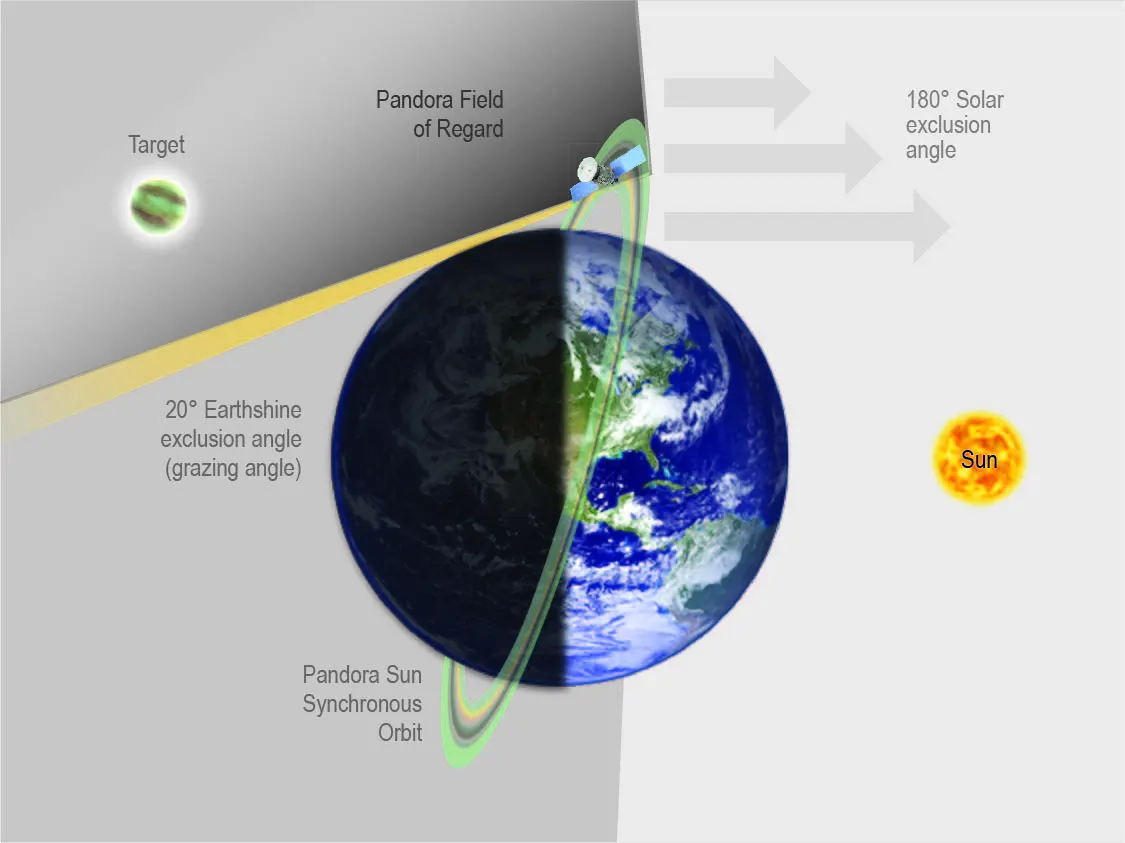
- Image: Image depicts Pandora’s orbital pattern in Sun-synchronous low-Earth orbit (NASA)
PRESS RELEASE — NASA has selected SpaceX of Starbase, Texas, to provide the launch service for the agency’s Pandora mission, which will study at least 20 known exoplanets and their host stars to find out how changes in stars affect our observations of exoplanet atmospheres.
The selection is part of NASA’s Venture-Class Acquisition of Dedicated and Rideshare (VADR) launch services contract. This contract allows the agency to make fixed-price indefinite-delivery/indefinite-quantity awards during VADR’s five-year ordering period, with a maximum total value of $300 million across all contracts.
During its one-year primary mission, Pandora will observe each exoplanet 10 times, observing for 24 hours each visit. It will capture critical data about the planet and its host star during transits, an event where a planet crosses in front of the star it orbits.
The satellite will use an innovative 17-inch (45-centimeter)-wide all-aluminum telescope to simultaneously measure the visible and near-infrared brightness of the host star and obtain near-infrared spectra of the transiting planet. This will allow scientists to cleanly separate star and planetary signals, knowledge that will enhance observations from NASA’s James Webb Space Telescope and future missions searching for habitable worlds, like the agency’s Habitable Worlds Observatory.
Pandora is a joint effort between NASA’s Goddard Space Flight Center in Greenbelt, Maryland, and Lawrence Livermore National Laboratory in California. The Astrophysics Pioneers program, from the Astrophysics Division at NASA Headquarters in Washington, funds Pandora and other astrophysics science missions using smaller, lower cost hardware and payloads. NASA’s Launch Services Program, based at the agency’s Kennedy Space Center in Florida, manages the VADR contract.
To learn more about NASA’s Pandora mission, visit: https://science.nasa.gov/mission/pandora