
Insider Brief:
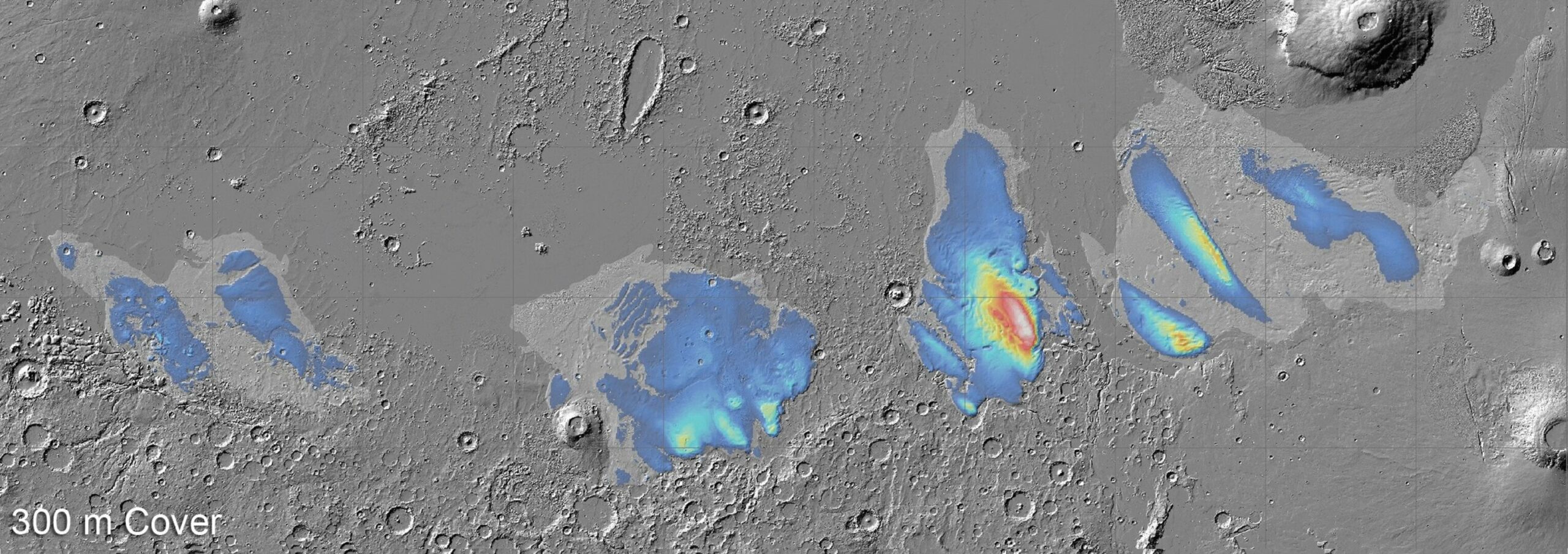
- The European Space Agency’s Mars Express has revisited Mars’s Medusae Fossae Formation (MFF), uncovering layers of water ice extending 3.7 kilometers beneath the planet’s equator.
- If melted, this buried ice in the MFF could cover Mars with a layer of water 1.5 to 2.7 meters deep, presenting a wealth of resources for potential human missions.
- While the ice deposits remain inaccessible for now, due to dust cover, this new discovery holds promise for future human exploration missions, providing an essential resource.
- Image credit: ESA
In a groundbreaking discovery, the European Space Agency’s Mars Express has revisited Mars’s Medusae Fossae Formation (MFF), uncovering layers of water ice extending several kilometers beneath the planet’s equator. Originally studied in 2007, the MFF’s massive deposits have now been revealed to be up to 3.7 km thick and are believed to hold the most significant water reservoir ever identified in this region of Mars.
Thomas Watters of the Smithsonian Institution is the lead author of both the most recent research and the initial study in 2007. He explains, “Excitingly, the radar signals match what we’d expect to see from layered ice, and are similar to the signals we see from Mars’s polar caps, which we know to be very ice-rich.” If melted, this buried ice in the MFF could cover Mars with a layer of water 1.5 to 2.7 meters deep, presenting a wealth of resources for potential human missions.
Previously thought to be windblown dust or volcanic ash, the MFF’s true composition has been clarified by new radar data from Mars Express’s MARSIS instrument. The findings suggest a combination of alternating layers of ice and dust, topped by a protective layer of dry dust or ash, challenging previous assumptions and raising new questions about Mars’s climate history.
Colin Wilson, ESA project scientist, emphasizes the significance of these discoveries: “This latest analysis challenges our understanding of the Medusae Fossae Formation, and raises as many questions as answers.” While the ice deposits remain inaccessible for now, due to dust cover, this new discovery holds promise for future human exploration missions, providing a valuable and essential resource.
The study also highlights the need for continued exploration and collaboration, as Mars Express and the ExoMars Trace Gas Orbiter work in tandem to uncover the Red Planet’s secrets. With missions to Mars becoming an inevitable reality, understanding the distribution of water resources, especially in equatorial regions, becomes crucial for planning and executing successful explorations.
Each discovery of water ice on Mars contributes to our evolving understanding of the planet’s past and potential for sustaining life. As scientific instruments like MARSIS and the Mars orbiter TGO continue to unveil Martian mysteries, the allure of our neighboring planet grows, paving the way for the next era of space exploration.
If you found this article to be informative, you can explore more current space industry news, exclusives, interviews, and podcasts.