

- Exclusives, Insights
A.I. Sparks Nuclear Fusion Rocket Breakthrough – Pulsar Fusion Begins Construction of the Largest Practical Nuclear Fusion Rocket Engine Ever Built
Space Insider pairs a market intelligence platform with strategic advisory for organizations making high-stakes decisions in the space economy. Powered by the wider Resonance intelligence engine and delivered by a team with backgrounds across strategy, investing, engineering, market intelligence, and public-sector advisory.
Insider Brief:
- Pulsar Fusion has started construction of the largest practical nuclear fusion rocket engine ever built.
- The 8-metre fusion chamber will be fired in 2027, and temporarily become the hottest place in the solar system creating exhaust speeds of over 500,000 MPH.
- The technology has the potential to halve mission times to Mars, reduce flight time to Saturn from 8 years to 2 and ultimately empower humanity to leave our solar system.
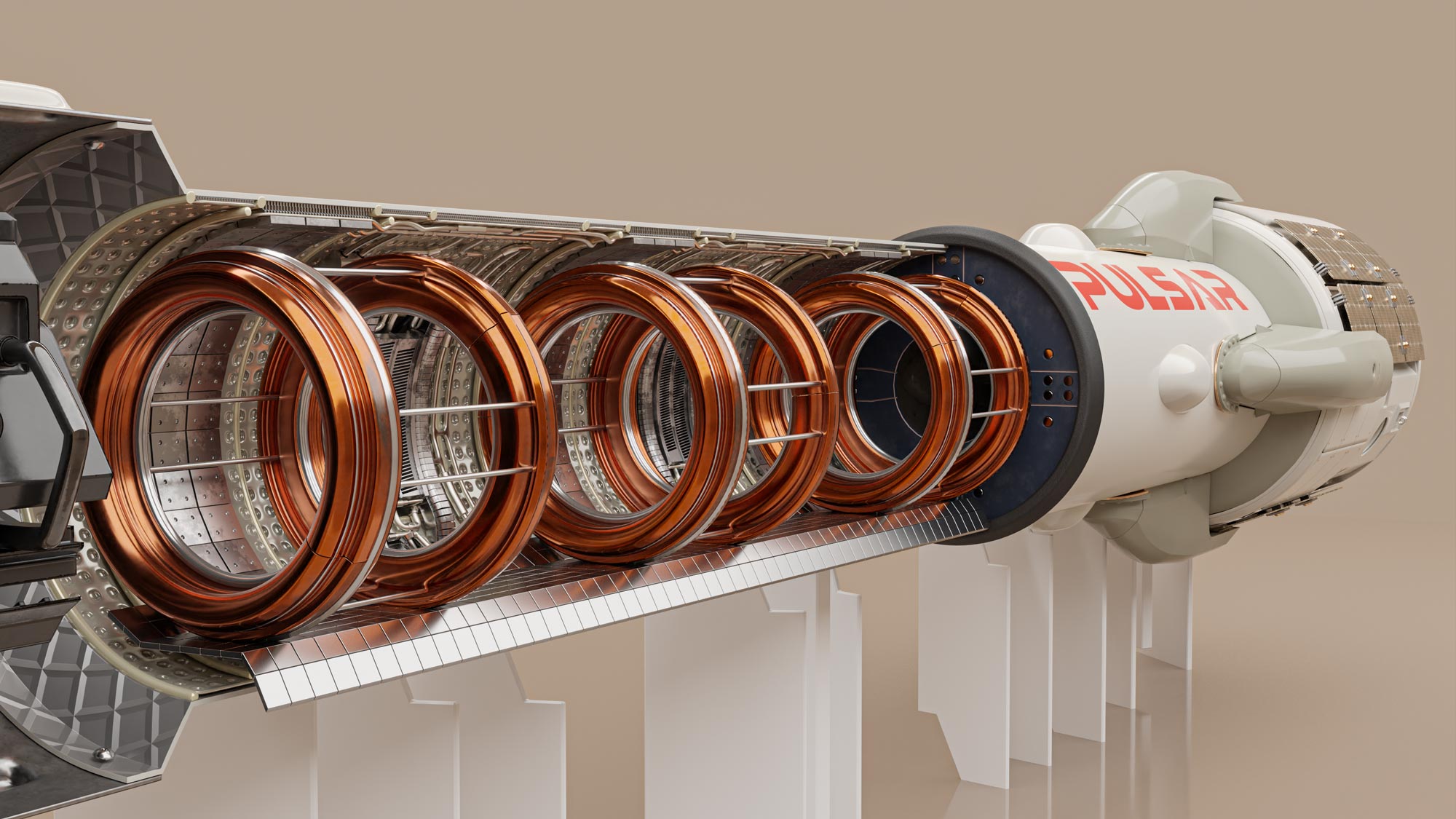
PRESS RELEASE — Bletchley, UK / July 10, 2023 — UK aerospace company, Pulsar Fusion, has started construction of the largest practical nuclear fusion rocket engine ever built. The 8-metre fusion chamber is being assembled in Bletchley, England and when fired in 2027, will temporarily become the hottest place in the solar system creating exhaust speeds of over 500,000 MPH.
Researchers at Pulsar Fusion hope to reach several hundred million degrees when the final plasma shot is fired in the chamber, creating temperatures hotter than the Sun.
“The difficulty is learning how to hold and confine the super-hot plasma within an electromagnetic field, ” said Dr James Lambert, CFO of Pulsar. “The plasma behaves like a weather system in terms of being incredibly hard to predict using conventional techniques.“Scientists have not been able to control the turbulent plasma as it is heated to hundreds of millions of degrees and the reaction simply stops. This unpredictability is attributed to the science Magneto-Hydro Dynamics (MHD) and Gyrokinetics, the state of the plasma is changing all the time. Scientists can get to fusion temperatures, as recently demonstrated at California’s Lawrence Livermore Laboratory, and this will be achieved again more often going forward, but small improvements can dramatically improve the results in our favour.”
Crucially, very recent advances in machine learning techniques may have changed the playing field in favour of scientists. Pulsar Fusions has teamed up with New Jersey-based Princeton Satellite Systems to take the data from the World record holding PFRC-2 reactor, feed it into supercomputer simulations to better predict how super-hot plasma behaves under electromagnetic confinement and thus, guide and improve the design of the rocket engine prototype.
“Our current satellite engines we make today at Pulsar, produce up to 25 miles per second in exhaust speeds. We hope to achieve over 10 times that with fusion,” said Pulsar CEO Richard Dinan.
If the Pulsar rocket test can achieve fusion temperatures at its demonstration to aerospace partners in 2027, then the technology has the potential to halve mission times to Mars, reduce flight time to Saturn from 8 years to 2 and ultimately empower humanity to leave our solar system.
”We will be keeping our existing partners up to date at every step even as we begin early firings in 2025, we will be able to know if we are on the right track. Pulsar would then need to conduct a test firing in orbit. To the fusion community, AI truly does have the potential to allow us to achieve engines capable of interstellar space travel,” Dinan saidIf you found this article to be informative, you can explore more current space industry news, exclusives, interviews, and podcasts.
SOURCE: Pulsar Fusion
Featured image: Fusion 1. Credit: Pulsar Fusion
Space Insider
Want the data behind this analysis?
Browse our market intelligence platform for live company data, funding, missions, and reports across the space economy.
Continue reading
More from Space Insider.

- Exclusives, Insights

- Exclusives, Insights